
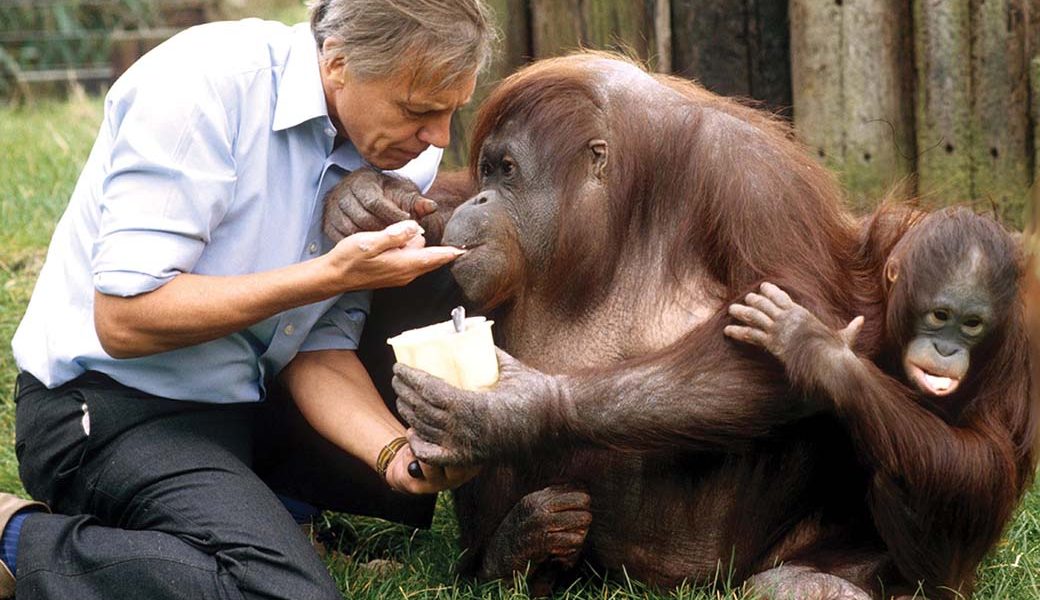
A Natural Icon
Sir David Attenborough achieved a milestone as a centenarian in May
A staff writer chats with the man who brought nature into our homes
To mark the moment that Sir David Attenborough became a centenarian, channels across the world dedicated special programming to the broadcaster, historian and writer as they celebrated a career that has not only defined television but also reshaped humanity’s understanding of the planet.
And Attenborough isn’t merely ref-lecting on his life’s work – he is still urging us forward.
For generations, he has been the voice that carried audiences across continents, oceans and epochs. His narration – measured, precise and quietly awed – has become synonymous with the natural world itself. Yet, for all the reverence with which he is held, there remains something disarmingly modest about his own view of that legacy.
“I’m certainly proud of the work I’ve done over the years,” Sir David says, almost reluctantly adding: “But I’m lucky that I’ve loved what I’ve been able to do. I’ve been granted a tremendous opportunity, afforded relatively good health and even stepped into the realms of longevity… I’m simply a lucky person.”
This is a typically Attenborough res-ponse – gently deflecting praise while subtly acknowledging the extraordinary span of a life that has intersected with some of the most important environmental and cultural moments of the modern age.
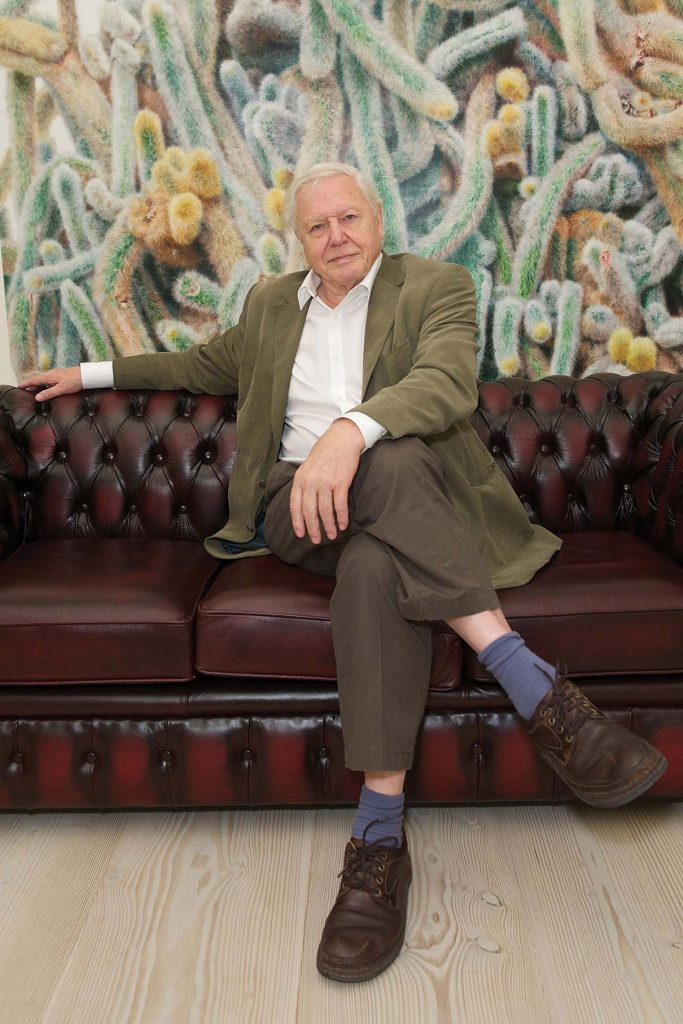
Sir David’s career began in 1952 when he joined a fledgling BBC where, as he recalls with a chuckle, “each and every programme we made was just awful.” Television itself was still in its infancy and seen by only a fraction of the population. “Ninety percent of the country didn’t see television at all and they were much better off without it!” he reminisces.
From those humble beginnings emerged a revolution in broadcasting. Through landmark series and tireless exploration, Attenborough transformed nature programming from niche curiosity into a global spectacle – and ultimately into something far more urgent. His early expeditions particularly across Africa, proved formative.
Sir David recalls: “I’d never been to the tropics before; and the first time I landed in Africa, I was simply blown sideways by what I saw: the sheer abundance and variety of life. I fell in love from that moment on and it’s an adoration that has never waned.”
That sense of awe would become the cornerstone of his work. From the Galápagos Islands to the Amazon rainforest, and from the depths of the oceans to the polar extremes, Attenborough’s documentaries revealed a planet of extraordinary complexity and fragile balance. Yet, for him, no single destination or species has ever eclipsed another.
“I understand that people want a favourite – yet, no one place or animal stands out more than another. The world is such a spectacular collection of majesty and wonder, and there’s still so much to see and explore,” he marvels.
Even now, at 100, that curiosity remains intact. Attenborough jokes: “I’m certainly aware of my advancing age – it’s rather difficult to ignore it. I can’t climb trees anymore because of my tricky knee… but why slow down? As long as I’m vertical, I will keep doing what I love.”
His longevity has allowed Sir David a rare perspective, one that stretches across decades of environmental change. He has witnessed ecosystems flourish; decline; and in some cases, recover. Few people alive can speak with such authority on the trajectory of the natural world.
Increasingly, Attenborough’s message has become one of warning: “The human race is continuing to grow. No matter what we do now, there are going to be a billion more people here within the next decade. Where are they all going to go? They all want to feed themselves, send their children to school, travel, build homes… but the planet can’t sustain such growth.”
Population is the issue that’s too often overlooked as he recognises: “We are overrunning the planet. And I worry.”


Alongside this sits the reality of climate change – a subject that Sir David admits he would rather not have had to focus on so heavily in his later work.
He continues: “I would much rather make films that are simply unadulterated pleasure in the natural world. But if you are aware of what’s happening, then you have a responsibility – and to ignore it would be irresponsible.”
For all the gravity of his warnings, however, Attenborough is careful not to surrender to despair. He has seen firsthand what can be achieved when awareness is matched by action. Conservation efforts across Africa, for example, have offered tangible hope.
“When we first visited the gorillas decades ago, they were clinging to survival. But now, there are far more of them. It’s incredibly heartwarming and it shows that if we act, we can make a difference,” he affirms.
These moments of success matter deeply to him – not as exceptions but as evidence. He asserts: “There are many talented, diligent individuals striving to protect the planet. And I salute them all. But we need more action and focus on the planet rather than the economy. That attitude needs to change.”
For all his global travels, Attenb-or-ough’s reflections often return to something far closer to home. In la-ter life, there is a quiet contentment in familiarity – in the simple act of being present in a place that holds memories; his base in Richmond, London.
He says: “I think it’s fairly natural to have that desire to be home – I’ve spent so much of my life travelling but now, I like my house very much. I have my garden and a kitchen with a lovely view. It’s a place full of memories.”
And yet, even here the natural world is never far away. Sir David explains: “I’ve been to the Great Barrier Reef, the Ama-zon and the Grand Canyon but there’s something so lovely about watching the deer in Richmond Park while the morning mist rises. It’s one of life’s simplest – yet greatest – gifts.”
It’s a reminder that Attenborough’s work has never been solely about distant, exotic landscapes. At its core, it has always been about connection: encouraging people to see the extra-ordinary in the everyday and recognise their place within a wider, living system.


He says: “For me, I’ve always felt I am merely the middle man, the messenger. The natural world does the work. I simply help to convey it.”
That role as interpreter, advocate and guide has made him one of the most trusted voices of the modern era. And remarkably, even at 100 years of age, there is no sense of finality in his outlook.
In terms of retirement, Sir David says lightly: “I’ll keep going until this old body suggests it’s time to give up. I couldn’t ever see myself not making documentaries – they have been my life.”
There is no clearer statement of intent than that. A century later, Attenborough remains driven not by legacy but by curiosity – and by the belief that there is still more to see, understand and protect.
In that sense, his greatest contribution may not be the countless hours of footage or the generations of viewers he has inspired but something far simpler – a reminder that the world is not ours to dominate but rather share.
He concludes: “We’ve no greater right to be on this planet than any other animal. Sometimes, we just need to step back and remember that. There is always time to act, do more and make the world a better place – so let’s do it!”