AMA JAYASINGHE
Finding her own Frequency
Her YouTube channel now features more than 80 videos, encompassing Sinhala and international favourites, live collaborations and original releases
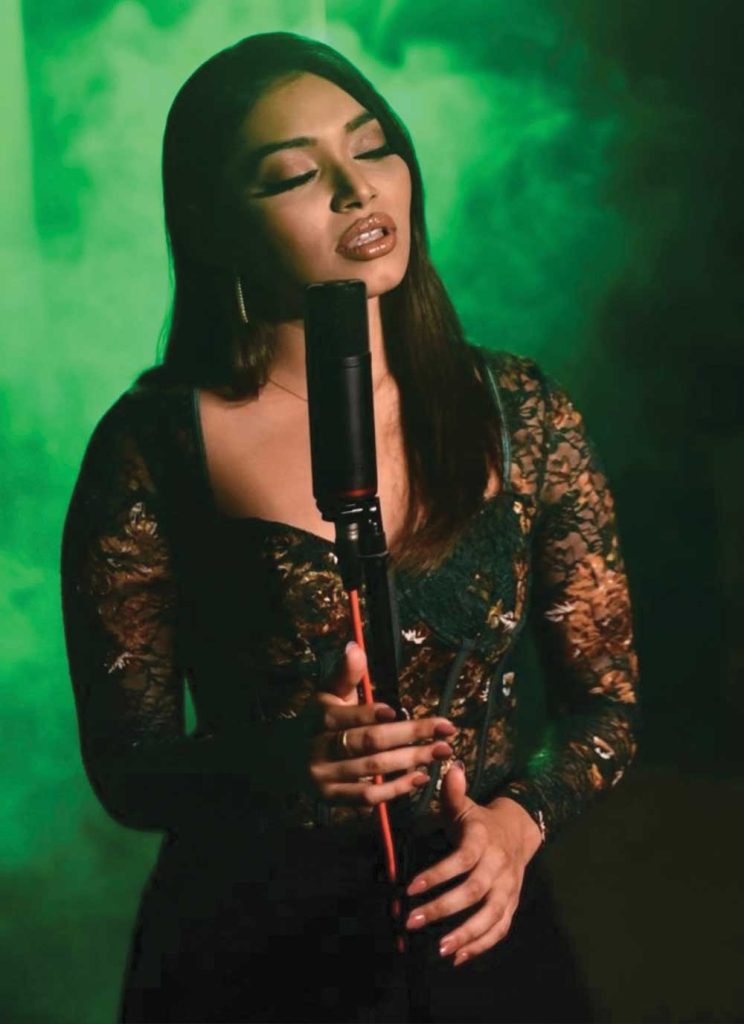
At a time when Sri Lanka’s emerging musicians are reaching audiences far beyond the island’s shores, Ama Jayasinghe is carving out a creative identity that feels distinctly her own.
With a growing catalogue of original music, the singer-songwriter belongs to a generation of young artistes who are equally at ease drawing from local musical traditions, and exploring the opportunities created by digital platforms and global influences.
Ama began attracting wider attention through online performances and covers, where her expressive vocals and natural stage presence helped forge an easy connection with listeners. Her YouTube channel now features more than 80 videos, encompassing Sinhala and international favourites, live collaborations and original releases.
And her performances with bands such as 2FORTY2, together with covers ranging from Wham! and Cher to contemporary Sinhala music, reflect an artiste with an instinctive curiosity and a willingness to move between genres.
Rather than allowing herself to be defined by a single musical style, Ama continues to experiment, interpret and discover where her voice fits best.
The shift from performing familiar songs to creating original work has marked an important stage in her artistic journey. It has also enabled her to become more closely involved in the creative process by moving beyond interpretation to explore songwriting, melody and collaboration.
Based in Melbourne at this time, Ama continues to share her music through digital releases and live performances, while remaining closely connected to Sri Lanka and its evolving musical landscape. Her journey has not been shaped by the pursuit of overnight success but something quieter and perhaps more enduring – consistency.
For Ama Jayasinghe, music is both a form of personal expression and an ever evolving pursuit.
In this exclusive interview, she speaks about her portfolio and determination to continue moving forward on her own terms.
– Compiled by Tamara Rebeira
About AMA
BIRTHDAY
20 May
SCHOOLING
Visakha Vidyalaya
FAMILY
- Father (Pasan Jayasinghe)
- Mother (Poorni Edirisinghe)
- Older brother (Gayath Jayasinghe)
- Grandfather (Nimal Jayasinghe)
- Grandmother (Maya Narasinghe)
- Dog (Tubby Jiggle Jayasinghe)
HABITS
- Waking up early
- Exercising
- Planning ahead
DRIVEN BY
Rainy days
YET TO TRY
A half marathon
ASPIRATIONS
Becoming a singer-musician, nutritionist and dietitian
LOVES
- Her dog (Tubby)
- Baking
- Chicken nuggets
PET PEEVES
- The sound of screeching metal
- When someone interrupts a conversation repeatedly
- Loud chewing
MUST-HAVES
- Protein bars
- Bottle of water
- Lip balm
LIKES
- A morning walk
- Visiting a market
- Baking chocolate chip cookies
PERSONAL RHYTHM
Q: When did you realise that music was more than a passion?
A: Back in 2013, during a jazz festival in Jaffna. I was 11 years old and part of an amateur music group comprising an ensemble of young musicians like myself, along with my brother, who was also a student at Music-matters.
We were given the opportunity to perform live at the International Jaffna Music Festival. The founders of Musicmatters – Dr. Sumudi Suraweera and Dr. Eshantha Peiris – helped bring out my ability to perform on stage and encouraged me to go beyond the rehearsal room.
I loved the ambience created by our shared love of music, and seeing people smile and enjoy what we delivered. It felt right!
That was when I realised that music was going to stay with me forever.
Q: How would you describe Ama Jayasinghe beyond the stage and studio?
A: A hardworking university student, a vocal trainer at Music Roof in Melbourne, and a person who is obsessed with watching ‘K-dramas,’ loves trying different food combinations and is a disciplined gym member.
Beyond music, the stage and studio, theatre is my other passion. I have been part of a few musical thea-tre productions in Sri Lanka – and it is definitely an important part of who I am beyond my musical career.
Q: What has been the defining moment in your musical journey so far?
A: Rather than having one particular moment, I enjoy the little achievements. From facing many obstacles and challenges to experiencing joyous moments on stage, I consider them all lifelong experiences.
During my short musical journey as a young artiste, I have created my own music by writing lyrics, composing melodies and releasing original songs. These have been the defining moments of my musical journey so far.
From facing many obstacles and challenges to experiencing joyous moments on stage, I consider them all lifelong experiences
GROUNDED AMBITION
Q: What does ‘success’ mean to you at this stage of your career?
A: Success to me is being able to express myself for who I am. As a performer, I wish to be as unique and authentic as possible. Whether it’s through my voice, expressions on stage, actions or music in general, I try my best to cater to the audience in my own unique way.
And I love to experiment with different genres: you will hear pop, jazz or even classical music from me. When I realise that I’ve explored different styles of music and people enjoy it, that is success for me.
I focus mainly on quality over quantity. And I wish to release high quality music productions throughout my journey – that too is success for me.
Q: How do you handle pressure, comparisons or criticism as a young public figure?
A: If you are a public figure, pressure and criticism are part and parcel of daily life. I’ve faced criticism on many occasions but I look at everything in a balanced manner.
Criticism is a way of expressing an opinion and can be useful if it is constructive.
Social media is an open platform where people are free to express their feelings. You need to be strong enough to embrace both the good and bad, and move on. Even encouragement can sometimes create pressure.
I’m grateful to be where I am in my career today; but pressure, comparisons and criticism will always follow me as I thrive… and I have accepted that.
Q: And what impact do you hope your music will have on listeners, going forward?
A: I hope they will genuinely enjoy the music I create – and that my music will give them a reason to feel happy and rejuvenated after a stressful day.
When I compose my original songs, especially in English, I write the lyrics and create a melody to suit the moment. It’s always something I can relate to.
FAVOURITES
MUSICIANS
- Celine Dion
- Ed Sheeran
- Frank Sinatra
HOLIDAY DESTINATIONS
- Japan
- Bali
- South Korea
CUISINE
- Italian
- Asian
- Mexican
BUCKET LIST
- A solo trip to South Korea
- Skydiving
- Visiting the Great Wall of China
PERFECT WEEKEND
- Watching K-dramas
- while eating popcorn
- A spontaneous road trip
- Visiting the library to
- study on a rainy day
CONFESSIONS
YOUR MUSIC IN THREE WORDS
Unique, exciting and challenging
YOUR GREATEST INSPIRATION
My parents – as they have sacrificed many things for my brother and me
A SONG THAT DEFINES YOU
She Used to be Mine –
by Sara Bareilles
YOUR DREAM COLLABORATION
With Ed Sheeran
IF YOUR LIFE HAD A SOUNDTRACK AT THIS MOMENT, WHAT WOULD IT SOUND LIKE?
Subway Surfers theme song
YOUR MAIN STRENGTH
My family and close friends
CREATIVE IDENTITY
Q: Your music includes both originals and covers. How do you balance honouring familiar songs with building your own identity?
A: I believe that as an artiste, singing covers help build a foundation for the style one wants to create. So I pick and choose the covers I perform as I don’t want to confuse my audience.
My covers are usually ballads, Sinhala baila songs or English classics while my originals are also slow, fast-paced like baila or classical in style.
Most of the Sinhala originals I have released feature melodies that I’ve composed. I create melodies that are authentic while maintaining a balance with my choice of covers.
Of course, I experiment with different versions when covering songs but that’s simply to show my audience that I can be versatile as an artiste. I try to build my own identity through authenticity but am still at the experimental stage.
And I hope my music is unique while honouring musical culture by representing many styles and forms.
Q: How has social media changed how young musicians are discovered and supported?
A: Isn’t social media making music a universal language? In today’s world, social media plays a major role in the lives of many individuals – especially young musicians.
Social media platforms are extremely helpful in helping young artistes such as myself gain recognition. Access to music is now available at the click of a button. Making music available to the world was a huge task a few decades ago but social media has definitely changed how young musicians are discovered and supported.
Once you post a song online, there’s a greater possibility of your music being recognised by producers, directors and other artistes in the industry – not only within the country but globally too.
I have been recognised by many producers, artistes and directors, all thanks to social media – and I’m very grateful for those opportunities. However, we must remember that nothing is perfect. Therefore, it’s important to use social media wisely despite the many benefits it offers talented individuals.
Q: Do you believe that Sri Lankan music is entering a new era of experimentation and individuality? And if so, how?
A: Yes! More and more local musicians are trying to create a distinctly Sri Lankan sound, not by simply copying and pasting popular trends, but combining traditional music such as folk music with cultural instruments and Western genres.
One of the main challenges the country has faced is taking local music to the international arena.
With the availability of modern technology and access to numerous streaming platforms, musicians now have the opportunity to reach foreign markets easily and build a local identity through technically advanced, high quality productions.
Another critical factor in experimenting and creating a Sri Lankan style is the country’s multilingual and vastly diverse culture. This is a major advantage for us. We’re hearing more and more songs that blend Sinhala, Tamil and English – and that will definitely help create a distinctly Sri Lankan signature of its own.
STUDENT LIFE
CURRENTLY STUDYING
Bachelor of Health Science (majoring in nutrition)
UNIVERSITY
Swinburne University of Technology (Melbourne)
PRESENTLY RESIDES IN
Melbourne
HOW DO YOU BALANCE STUDIES AND MUSIC?
I wouldn’t say I’m perfect at balancing my studies and music – but I make a conscious effort to remain consistent. I plan ahead by reviewing lecture content on the same day, starting assignments early and regularly recording or working on new songs.
Whenever I have breaks at the studio where I teach, I also record live performances to maintain a consistent presence on social media.
WHEN DO YOU HOPE TO RETURN TO SRI LANKA?
Soon
YOUR OVERSEAS CHAPTER IN ONE WORD
Roller coaster
INNER COMPASS
Q: What is the dream you’re working towards?
A: My dream is to continue doing what I love, which is balancing music and academics. I moved to Melbourne in 2024 to pursue higher education as a nutrition major but that hasn’t stopped me from releasing new music for my audience.
Sometimes, it becomes quite challenging to balance everything with my studies but I try to remain as consistent as possible. I have performed in Melbourne on many occasions, at weddings and corporate events, and I don’t intend to stop thriving on stage.
Over the past two years, I have been releasing new music and am planning to release another song very soon. My steps may seem small as an artiste but I try to be as regular as possible.
Upon graduation, I want to work as a nutritionist while teaching music and creating unique music, not only for my listeners but myself too. I wish to share my knowledge of music through teaching for as long as possible.
And while all this may seem easier said than done, it’s the dream that I am working towards.
Success to me is being able to express myself for who I am
Q: And what keeps you grounded as your fan base grows?
A: Simplicity, my family and living in touch with reality. I’m extremely lucky to have had a humble upbringing in an artistic and close-knit family. As my fan base grows, I become increasingly grateful. And I never forget who I am or the people around me – that’s what keeps me grounded.
Q: Finally, what advice would you offer young people who are trying to find their voice, so to speak?
A: Never be afraid of who you are or showing what you have to offer. You are unique – so don’t be afraid to embrace that. Never be afraid to try new things; and even if you fail, that is perfectly fine. You can always try again.
Don’t procrastinate – it will only hold you back. Life can’t be perfect and you should always remember that. Whether it’s singing, dancing, drawing or any other activity, once you try it, the results may take time to appear – and that’s fine.
It is also okay not to be okay. That doesn’t mean that you have failed; it simply means that you have taken the first step and initiated something. After that, keep building until you reach your goals. I know it’s easier said than done but you will never know until you start.